










https://doi.org/10.66242/EEHZ8719
Download this review as a Word Document
Return to Issue 6
Marc W. S. Jaffré, The Courtiers and the Court of Louis XIII, 1610-1643. Oxford: Oxford University Press, 2025. xviii+384pp. figures, bibliography, and indices. £119.00 (cl) ISBN: 9780198957614.
Author’s Response by Marc W. S. Jaffré, Istituto Storico Italo-Germanico (ISIG) and International Center for Japanese Studies (国際日本文化研究センター)[1]
A mentor once described the process of adapting a PhD thesis for publication as akin to “a dog returning to its own vomit.” The idea behind the graphic simile was that it can be uncomfortable to be confronted with what one has written and to go through a process of rethinking, rewriting, and rearranging. For me, the key difficulty resided in being continually reminded that what appeared at first glance to be an ending was in fact merely the beginning of a new chapter within a longer journey. Academic research is full of such false endings. Submitting and defending the PhD thesis was merely the midway point of this book adventure, and submitting the book manuscript proved not to be a real ending either. Instead, it only marked the start of a long process involving peer reviews, copy editing, and proofs. Even now, over a year after the book’s publication and as reviews start to trickle in, I am coming to the realization that a research project is never truly over. Indeed, there will always be opportunities to reengage with old ideas.
This is a particularly opportune moment to look back on my first project, since I am setting off for Japan to undertake research for my second monograph: a comparative study of hospitality in early modern France and Tokugawa Japan. The exercise has proven fruitful helping me think through what drives my research, what shapes my perspectives on history, and what characterizes my approach to the discipline. It is in this spirit that I have put together my response to the three reviews contained within this Forum. I have structured this response in three parts. Firstly, I discuss my reasons for focusing on the court in terms of its institutions and its structures rather than taking the king’s perspective along with the implications of this choice. Secondly, I examine the book’s advocacy for an expanded conception of court life. In the final section, I reflect on the methodologies that shaped the book and my approach to history, both consciously and subconsciously.
Institutions and People
This monograph is not about a monarch, a reign, or even a specific set of characters. It is first and foremost a book about an institution, its development, its politics, its culture, its economics, and its travels. Princely courts, like most successful institutions, have existed and thrived in so many time periods and in so many separate cultures because they served the needs of a significant number of people. A court like that of France attracted into its orbit many noblemen, noblewomen, clergymen, soldiers, professional hunters, financiers, merchants, artists, and musicians. This large swathe of people held a stake in the court as an institution and therefore invested their time and energy into building their relationship with the court and adapting it to their needs. Yet when historians have considered the development of courts, it is not to these courtiers that they have looked for answers. Instead, historians have privileged narratives relating to the development of the state, the rise of absolutism, and the needs and personalities of individual monarchs, their queens, and their favorite ministers.
By eschewing these totalizing frameworks and decentering the monarch from the study of his court, the activities of his courtiers—from lowly ushers to the great princes of the realm—and the importance of their impact on the development of the court become clearer and easier to apprehend. This choice was by no means an attempt to imagine a court functioning without a monarch. The court could not have existed without him; in the book, I emphasized that its development was the result of a dialogue between the needs and desires of the king and those of his courtiers (pp. 5, 73, 220, 313). However, shifting the focus away from the king and onto his courtiers allows us to see the usher fighting for changes in the organization of their labor, to understand why French kings were brought food by kitchen boys and not by lords as Cardinal Richelieu would have wanted, and to begin to grasp the importance of court ceremonies and entertainment for the wider court. The image of change and development that emerges is far messier than neat modernizing and absolutist narratives allow and demonstrates the importance of taking a broader view of the court and its actors if we truly want to understand how it functioned. The historiographical emphasis on the king’s perspective and the development of the state not only ignores a key engine of the court’s development but has also led to courts, like Louis XIII’s, which do not fit in traditional modernization narratives or whose monarchs are not considered interesting enough, to be overlooked.
The choice to decenter the king naturally has as a consequence that Louis XIII is not as central to this book as one might initially expect. I often get asked by friends and academics alike what fascinates me about Louis XIII. My go-to answer is generally that I do not find Louis XIII interesting; it is his court which compels me. While this is a tongue-in-cheek answer, there is an underlying truth to it that clearly shaped the monograph I wrote. I therefore might not be the best placed historian to answer Adam Horsley’s questions about Louis XIII’s sexuality. Nonetheless, I inevitably have some initial thoughts on the topic. It seems to me that much of the discussion surrounding the sexuality of Louis XIII was shaped at a time when historians still had a very binary view of sexuality: either someone was homosexual or heterosexual. The possibility of other sexualities, such as bisexuality or asexuality, were not yet part of general academic discourse. In this context, Louis’s poor relationship with his wife, his lack of mistresses, his close relationships with male favorites, coupled with the long delay between his marriage in 1615 and his siring an heir in 1638, all seemed to point toward a possible homosexuality.
Certainly, Louis’s lack of sexual interest in his wife was an early topic of concern. The Venetian ambassadors Ottavio Bon and Andrea Gussoni reported in May 1617 that in reaction to the insistence of the Spanish ambassador, Hector Pignatelli, duke of Monteleone, that Louis “consummate” his marriage with Queen Anne, Louis had replied that both he and she were “too young” and that the consummation of the marriage should be delayed at least another year.[2] Sir Thomas Edmondes, the English ambassador, wrote in September that the evening of the wedding between Charles d’Albert, duc de Luynes, and Marie de Rohan, duchesse de Chevreuse, Louis could not be induced to go to the queen’s chamber despite an earlier promise that he would sleep with her that night.[3] The papal nuncio, Guido Bentivoglio, wrote to the cardinal-nephew on 19 December of that year: “It is certain that we do not yet see any kind of tenderness from the king toward the queen, though up till now, he has not shown any toward other ladies either.”[4] Less than a month later, he reported on a conversation he had with the king’s confessor, Jean Arnoux, who had advised Louis during his latest confession to love his wife and think about being a good husband to her.[5] On 17 January 1618, Bentivoglio was writing again that the court had hoped that the king would finally sleep with the queen in Saint-Germain-en-Laye and “to once and for all be a husband.”[6] But faced with Louis’s flat refusal, some of his councilors began suggesting that he should first try sleeping with another woman who had already had sex, rather than try to prove his mettle with a virgin like Queen Anne.[7] On 14 April of the same year, Bentivoglio wrote that he had recently liaised between the Spanish ambassador, Monteleone; the queen’s Spanish first lady of honor, Inés Enríquez y Sandoval, countess of la Torre; and the confessor Arnoux about the king’s reluctance to sleep with his wife.[8] Bentivoglio concluded: “it seems strange, to tell the truth, that the king who is now nearing 18 years old, is taking so long to build his resolve to take the actions of a husband.”[9] Later that same month, Arnoux again broached the topic with Louis during confession. Louis explained himself saying that he thought well of the queen and he would not fail in his duty toward her, that at times he had felt great desire to do so, but that he worried by beginning too young that he would perform badly.[10] The problem was still not resolved in early January 1619, and the French court supposedly consoled itself with the (spurious?) notion that Louis XIII’s father, Henri IV, the infamous vert-galant, had also taken to “knowing” women very late.[11] Finally, Bentivoglio was able to report that on the night of 25 January 1619, Louis had resolved to sleep with the queen to the great relief of the entire court. Apparently, Louis’s favorite, Luynes, had taken Louis by the hand and led him “almost by force” to the queen’s bed.[12]
Some might wonder how it can be that Louis waited until 25 January 1619 to consummate his marriage with his wife. Indeed, relations of his wedding ceremonies in 1615 claim that Louis consummated his marriage on the very night that their wedding was recelebrated (they had already been married by proxy) in the church of Bordeaux. According to these relations, Marie de’ Medici had come to Louis’s room and told him “mon fils, ce n’est pas tout d’estre marié, Il faut que Vous Veniés Voir la Reine Vostre femme qui vous attend.”[13] Louis went to Anne’s room accompanied by his mother, his and Anne’s wetnurses, the first gentleman of the Chamber, the first physician, the master of the Wardrobe, and the first groom of the Chamber. After enjoining Anne to sleep with Louis, Queen Marie left the room along with all the men, leaving only the two wetnurses with the newlyweds. We are then told that during the hour and a half that Louis was alone with Anne he consummated the marriage—not once but twice—and that this was reported not only by Louis himself but also confirmed by the wetnurses.[14] The first physician, Jean Héroard, separately recorded that Louis claimed to have slept with the queen twice and upon checking the king’s penis for evidence, he noted that it was redder than usual.[15] But considering that three years later no one seems to believe that the marriage was consummated, I am inclined to believe that this early consummation was a convenient fiction. In any case, if anyone hoped that Louis’s sleeping with Anne in January 1619 would be the beginning of a long enduring physical relationship, they were rapidly disabused. Despite a miscarriage in 1621 and of course the two pregnancies that led to the birth of Louis XIV and his younger brother, Louis’s visits to the conjugal bed were very rare indeed.
But does Louis XIII’s aversion for sex with his wife mean he was homosexual? Louis XIII did indeed have a long succession of male favorites, but we should not forget Louis’s infatuations with Marie de Hautefort and Louise de Lafayette. It is not clear to me why the existence of his male favorites should stand as evidence for same-sex attraction but that his female favorites should not equally be evidence for attraction to the opposite sex. At best his list of favorites point to bisexuality rather than homosexuality. Still, this seems like very scant evidence to go on. I have encountered no suggestion in any contemporary memoir, correspondence, or even political pamphlet that Louis’s relationships with his favorites were sexual in nature.[16] We have nothing comparable to the letters King James VI and I wrote to the Duke of Buckingham for Louis’s case.[17]
Contemporaries had no qualms about hinting at other people’s same-sex appetites. Bentivoglio, for instance, said of the prince de Condé: “He, in particular, leads an extremely ugly life, showing himself entirely devoted to wine and food, in places with disreputable men, and, what is worse, to dishonest pleasures, all the worse for not being those of women.”[18] Far from believing that Louis might have same-sex relations with men, Bentivoglio suggested that the king could not even fathom the possibility of men having sex with men. He remarks on Louis’s naïveté in believing that his cousin Condé was simply visiting brothels with his male companions: “His Majesty doesn’t even know the truth of it, because he is so innocent as to think that they [the disreputable men] accompany him only to public places of women, without thinking of worse things.”[19] Personally, I believe the idea Louis XIII may have been asexual, experiencing no sexual interest toward either gender (which would not preclude the possibility of emotional or even romantic attachments to men and women), aligns better with the evidence we have at our disposal. In any case, given the complexity of human sexuality, I think it important that historians move beyond the heterosexual/homosexual dichotomy that is still so prevalent in discussions of royal favorites and sexuality.
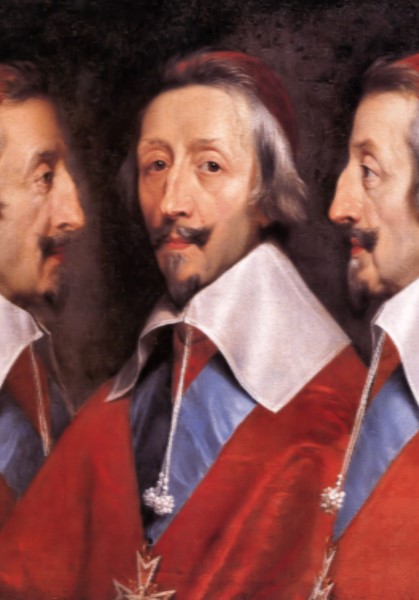
It is not just Louis XIII who is decentered in this study: the infamous Three Musketeers villain, Cardinal Richelieu, is also relegated to a side character (though admittedly an important one). In the case of Richelieu, this deemphasis can be particularly jarring because Louis XIII’s reign is often presented as Richelieu’s story. When I was researching and writing this book, I was very conscious that there was a risk that a book about Louis’s court could end up being about Richelieu and the court instead. This risk had been made clear to me by Sharon Kettering who, in her book on Charles d’Albert demonstrated that Richelieu used his writings, including his ten-volume memoirs and his Testament politique, along with the many books written by his clients, to craft narratives about the reign and Richelieu’s role within it.[20] As I point out in my book’s introduction, Richelieu’s perspective was further amplified by later historians, both because they privileged publishing editions of his correspondence and writings over those of other political actors and because they accorded more weight to his thoughts and ideas (pp. 13–15). So, much like decentering the monarch, “sidelining” Richelieu in the study, as Horsley puts it, was a deliberate decision in order to make more visible the role played by other court actors.
Despite these efforts, Richelieu nonetheless remains a key figure within the monograph. This outcome is because Richelieu neither could afford to ignore the court, nor was able to effectively control it. Institutionally, his status as a bishop and then a cardinal was a disadvantage because it limited the positions within the royal households that he could have conceivably held (pp. 100–1). The relatively small number of relatives he could place in these households compounded his disadvantage. He was forced as a result to rely on purges and proxies to control not only the king’s household but those of Marie de’ Medici, Anne of Austria, and the king’s brother, Gaston. Unfortunately for Richelieu, many of those he entrusted with this key mission, from Marie de Hautefort to Henri Coeffier de Ruzé d’Effiat, marquis de Cinq-Mars, successively turned against him, revealing both the scale of the antipathy Richelieu engendered at court and also the fragility of his hold over Louis (pp. 101–3).
Richelieu’s position as a favorite, far from shielding the king from criticism as has sometimes been argued, was a greatly destabilizing force: it did not matter that the king had delegated his authority to him, contemporaries viewed favorites not as legitimate agents endorsed by the king but as “actors who had seduced the king and dominated his affections […] They and their actions were, in other words, inherently illegitimate” (p. 107). Richelieu’s perceived illegitimacy was only made worse by his insistence on portraying his political enemies as enemies of state. This tactic may have reinforced Richelieu’s position at court, but it also complicated reconciliations with the king, freezing detractors out, leaving many noblemen with few other options than to rebel or to participate in court conspiracies (pp. 112–3). The instabilities of Louis’s reign should therefore be viewed less as the last hurrah of a nobility resisting against the encroachments of the absolutist state and more as the direct consequence of Richelieu’s deleterious attempts to secure his position at court.
The analysis of Richelieu’s actions within the court further demonstrates the many problems that arise from interpreting the relationship between the cardinal and Louis XIII as an equal partnership. Richelieu’s difficulties in controlling the king’s household and the constant threat that the royal family posed to his power show that Richelieu never felt that his power was secure. The possibility of being overturned by another court favorite or being dislodged by Gaston, Marie de’ Medici, or even princes of the blood like Louis de Bourbon, comte de Soissons, haunted him until his death. The fact that a succession of favorites initially supported by Richelieu turned against him indicates that his political enemies also felt like he could be dislodged. Had they been certain of Louis XIII’s support for the cardinal, they would not have risked everything by organizing court conspiracies against him—no matter how much they chafed under his control.
One aspect of the court as an institution that could have come into greater focus in the book is the importance of gender. The French court, as Horsley rightly notes, remained in the seventeenth century a very gendered institution, and this is true both in terms of its organizational spaces and in the differing roles men and women were expected to play at court. I repeatedly discussed within the book queenship, salons, and the presence of women at the court while it was on campaign.[21] Admittedly, I could have analyzed with greater depth both how gender structured the court itself and how the court shaped gender relations. These questions come into greater focus in my 2026 English Historical Review article “Sociability and Diplomacy at Louis XIII’s Court,” a third of which is dedicated to how gender complicated diplomatic sociability at the French court.[22] In the article, I make the case that we tend to forget that the French court continued to be partially segregated along gender lines. Whereas Versailles remained throughout Louis XIII’s reign a male space, the chambers of the queens were predominantly female spaces. This gendered reality had important political implications for a court society where the chamber was the locus of so much political activity. Indeed, it was not just French kings who received important guests in the bedchamber: queens, princesses of the blood, and powerful noblewomen did so as well. But this brought the ritual function of bedchambers into conflict with expectations regarding the appropriateness of men and women meeting in bedchambers. Henri IV, when he was king, had already banned men from entering the queen’s chamber in his absence, and Louis XIII attempted to do the same on more than one occasion. The repeated bans, however, point to the difficulties inherent in enforcing such rules in a court where these restrictions would have severely limited queens’ and noblewomen’s political action.[23]
Foreigners often noted the political influence and power that French women (not just the queens) wielded at court. For foreigners and diplomats this often entailed having to enter in female spaces and build relationships that went against gendered norms and expectations. Politically active women, like the duchesse de Chevreuse, were frequently accused of sleeping with men for political advantage. When Chevreuse was tied to the Chalais conspiracy, her relations with Watt Montague (then a go-between employed by the British embassy), with Chalais, and with the English ambassador Henry Rich, earl of Holland, were all cast in a sexual light. Even the queen, Anne of Austria, fell afoul of gendered expectations when her diplomatic encounters with the Duke of Buckingham were recast as sexual trysts.[24] Politics involving female courtiers forced men to frequent female court spaces and to maintain friendships and relations with noblewomen that transgressed gendered expectations. Like many other transgressive behaviors, this political sociability was often reinterpreted through a sexual lens.[25]
The construction of gender is often conceived as emerging from relations between men and women, but at the French court ideas about masculinity could be developed with little female input. Horsley asks whether the court noblemen taking on risks and strutting onto the battlefield were performing for the female gaze, but it seems to me that the king’s presence was more determinative than the female spectators in explaining this behavior. For one thing, there were many instances of foolhardy risk taking when the ladies of the court were not present. Secondly, many studies have shown that in male dominated societies, virility is often performed more to impress other men than to attract women. This phenomenon is not unique to the court but is still very evident today in James Bond movies, in the manosphere, and among today’s tech moguls.
Expanding conceptions of court life
Aside from pushing historians to rethink how they understand the development of the court, a second goal of the monograph is to expand our conceptions of what constitutes court life. The aim grew out of my ambition to write as comprehensive a history of Louis XIII’s court as possible. Fragmentary approaches to princely courts have been a particular problem for our understanding of Louis XIII’s court because aside from an unpublished thesis written in the 1990s, there existed no overarching study of his court. As a result, older assumptions about his court—that it was disorderly, unimportant, backwards, lacking in sophistication, and dominated by Cardinal Richelieu—proved remarkably tenacious (pp. 13–14).
Studies of royal courts in the past two decades have become increasingly narrow, focusing on a single aspect of a court rather than embracing more holistic approaches. This relates to larger trends in history driven by funders, fears over the feasibility of larger projects, and the pressure to publish more frequently. While this specialized work has done much to advance our understanding, the fragmentary nature of these approaches can lead to larger trends being missed and to the development of misunderstandings as these studies become unmoored from wider contexts. It is also harder for these studies to make a broad impact because of the more limited readership they attract. As a result, important insights get cordoned off in subfields without permeating the wider historiography. On a more personal level, it is one of the great joys of working on court history that one does not have to limit oneself to either cultural, political, institutional, or economic history, but that one can employ approaches and methods from across the historiographical board.
Driven by this motivation to be comprehensive, I came to two key realizations. Firstly, historians working on different subfields of the court were not defining the court in the same ways. Secondly, groups not typically associated with the court had a much larger impact on its development and were much more embedded in court life than has been typically accepted. I am far from the first to make this remark, but a key difficulty facing court historians is how precisely to define the “court” and by extension the “courtiers” who inhabit it. This difficulty is compounded by the cavalier and imprecise way in which the term is sometimes used in popular histories. Moreover, definitions in academia are elaborated with specific aims in mind, and so political historians, cultural historians, and institutional historians often have differing views for instance on the degree to which the king’s household should be considered a part of the court. As court history as a discipline becomes increasingly atomized and specialized, definitions also tend to become narrower. What the court is as an “institution” does not necessarily map neatly onto what we mean by “court culture,” or what we understand to be “court politics.” Because my ambition was to write a comprehensive study of the court, covering its institutional, political, cultural, and economic aspects, I favored an expansive definition of the court: “A court is the entourage, organized around a household structure, of a person of authority, the society that they form, and the place where this person resided.” A court is therefore a place, a group of people, and a society all at once (pp. 5–8).
This last element of my definition is important, especially for analyzing court culture. I pose the problem in the book in the following way: do noblemen and household officers in the queen’s entourage cease to be part of court society in the king’s absence (p. 8)? Similarly, is a ballet performed in front of the king only part of court culture if the king is present? Is the exact same ballet performed two days later in the Hôtel de Ville no longer related to court culture if the king doesn’t attend a second time? Clearly court culture and court society cannot simply be defined in relation to the king’s presence in the way that Spangler proposes it should be. The point is not to show, as he suggests, “that ‘the court’ at its broadest sense functioned with or without the person of the monarch, a ‘decentring of the king’” or that the court “could have existed without him.” The point is the following: can you really say that salon culture is distinct from court culture if the people who were engaging in it are the same people as those attending the king and if they are engaging in the same behaviors and activities as they would have been at court? “While the Parisian entertainments of the nobility did have a role in establishing Paris as a nexus of entertainment for elite society, the lack of development of a distinct culture and the overlap between participants meant that these urban amusements remained for the duration of Louis’s reign an extension of court culture” (p. 195).
Decentering the monarch comes into play here in trying to take more seriously the role of entertainment at court. We already know that court entertainment fulfilled a variety of social, cultural, and political functions for the king, the royal family, and people like Cardinal Richelieu. However, the social, cultural and political roles that entertainment played for ordinary courtiers is not always taken as seriously. Indeed, courtiers were not simply looking elsewhere for entertainment because they were bored: entertainment was a vital tool employed by courtiers for showing off their proximity to the monarch, their polish, and their gallantry. Politically, it was additionally a useful tool for strengthening bonds with clients, patrons and allies alike. But what happens when a king like Louis XIII ceases to provide the stage that the nobility needed to show off their skills with the lute and the guitar, in the hunt, dancing, on the tennis court, in the wrestling ring, jumping, swimming, and sharp-shooting (the skills Nicolas Faret identified as making “un homme accomply”)?[26] Courtiers were forced to look elsewhere, which in turn isolated the king and made the court feel less radiant. Thus, Louis’s reclusive entertainment tastes were so harmful to his reputation not just because he was not engaging in the kinds of entertainment that were expected from a king but also because he was not providing the stage the nobility required to show off their skills (pp. 188–96). This dynamic only becomes clear when we step back from what entertainment meant for the king to properly consider the role it played in wider court society.
Given that I have deliberately favored an expansive definition of the court, it should not be surprising that I am also advocating for a larger understanding of what it means to be a courtier. In the book I argued that court merchants (as well as financiers) should be thought of as courtiers because they engaged with the world of the court with similar goals to other courtiers: they served at court in the hopes of raising their social status, in order to build patron/client relationships with other courtiers, and to acquire privileges and financial advantages (pp. 250–8). Additionally, their work created chances for sociability within the court and could provide important marriage opportunities with noble courtiers. In this sense, the appeal of court positions for these merchants “was not simply the possibility of profiting from their connections with the court, but rather the opportunity they afforded to become part of court society” (p. 258).
Spangler objects to this categorization on two grounds: first on the basis that “contemporary texts often state desires to go to court or to become courtiers,” and secondly because printed genealogies make clear that “a line was crossed once a financier or merchant’s son obtained a major military post or court office and no longer considered himself a bourgeois.” To the first objection, I would like to ask for clarification because I am unaware of any “contemporary text” written by a merchant or financier who held a court position, which discusses how they understood their relationship with the court. The second objection pertains more to nobility, rather than to whether merchants could be courtiers. On this latter point, my book argues that ennoblement was often a generational process, “whereby after the initial ennobling act obtaining successive royal confirmations of nobility helped to strengthen one’s claim to noble status.” Thus, one should not regard the fact that the noble status of ennobled merchants could be contested as a sign of the failure of their strategies for noble advancement: “What was important was that their association with the court had allowed them on behalf of their families to put their foot in the door” (p. 257). I would also add that printed genealogies looked backwards on a family history—which included an ennoblement in the past—that was often reinterpreted, or at times outright fabricated. Merchant courtiers, on the other hand, were looking to acquire nobility for their families going forward. They were not at the same stage of their ennoblement history and so it is not surprising that they should adopt different stances on nobility and elaborate different strategies for obtaining it.
Beyond these points, there is a historiographical rationale for including these merchants within definitions of the court. As historians, we do not always define terms in the way that they would have been understood by contemporaries (this problematically assumes in any case that contemporaries would have all agreed on how to define who was and was not a courtier). Instead, we elaborate definitions that allow us to study specific problems. As all three reviewers note, historians have not systematically studied court merchants, their strategies, and the extent to which they were enmeshed in court life. This dearth is because historians tend not to think about merchants as belonging to the world of the court. Their study becomes possible once we begin to think of them as integral parts of court society. I believe Spangler will agree that this endeavor was worthwhile since he characterized the chapter devoted to them as one of “the most innovative chapters of the book.” My conclusion that these merchants were “courtiers through and through” thus stands as an invitation to other court historians to take a greater interest in the relationship between merchants and the court (p. 258).
Methodology
When I was writing this book, I did not give any great thought to defining what my methodology was, and I certainly did not think of my book as methodologically motivated. Reflecting on reactions to my book, however, I have come to realize how archivally driven my work is. Adam Horsley mentioned the monograph’s “masterful command of sources”; for Nicolas Le Roux my approach is “située au plus près des sources,” and Jonathan Spangler emphasized that the book is “richly supported by archival material.” One of the book’s peer reviewers went so far as to write that they anticipated that the book would be “used historiographically, as an illustration of the power of close attention to primary sources.” But while Spangler asserts that the archival material was “assembled to support [the] overall argument,” this assessment in fact reverses the process: I assembled the archival material first and built the argument afterwards.
When I first started my research into Louis XIII’s court, I did not think I was going to be interested in the royal household, the court’s economic aspects, or in court merchants and yet these ended up being key portions of my book. It was only through poring over royal account books, notarial contracts, and minutes of the council of finance that I came to see how directly involved courtiers—including household officers and merchants—were in driving the development of the court. And in this I must acknowledge my debt to Robin Briggs, who generously gave up his time to offer me one-on-one paleography training during my MPhil, which equipped me with the necessary skills to accomplish this kind of research. The realization that the archive plays such a large role in driving my research has led me in my latest article on dwarfism at the French court to argue explicitly for the benefits of more archival approaches to studies of marginalized groups in the early modern period.[27]
The case for the archive can seem a little trite coming from a historian, but it is worth lingering on given that this way of working is increasingly under threat. On the one hand, access to archives is becoming more and more complicated for historians working abroad. Indeed, as universities cut student-staff ratios and increase both teaching and administrative burdens on lecturers and professors, it is becoming harder for historians to find the time and energy to really spend time in the archive sitting with the sources. This problem is compounded by the significant cuts in research funding across the UK and the USA, forcing academics to take fewer archive trips, or to find ways to fund them out of pocket. To compensate, university administrations are pushing ever more aggressively for academics to adopt digital and big-data approaches that have their value but that do not encourage the same direct engagement with and distance from archival sources. The rise of AI approaches will only further degrade historians’ ability to critically engage archival material. At the same time, academia’s reliance on external funding bodies has pushed historians to identify the KPIs (key performance indicators), results, and outcomes of their research before ever setting foot in an archive in order to secure financial support for their projects. This is a problem I am particularly leery of as I begin the research for my second book project, funded by an MSCA global fellowship.
Nicolas Le Roux accurately points out that my research is also driven by a deep antipathy toward grand narratives charting the modernization of societies and human progress. It is not so much that I reject that things have changed, or even that I do not think that things are better today than they were under Louis XIII, but more that I understand change to be messy and to rarely occur in a way that fits well into large-scale narratives. Take the question of the court’s itinerancy. I realize that Robert R. Harding was writing in 1978, but it is astounding to me that in the face of all evidence to the contrary he could argue that Louis XIII’s court was a centralizing force because it became fixed in Paris.[28] As I show in the book, far from being fixed in the capital city, Louis XIII’s court was the most itinerant court since at least Henri II’s, and other historians have in recent years poked holes into the idea that there was a long-term trend toward a fixed court (pp. 261–84). Spangler says this is all well and good for Louis XIII’s court and even for Louis XIV’s court, but that the “longue-durée approach” shows that the court was fixed in the eighteenth century. But does this not confuse a longue-durée approach with teleology? If the court became more fixed under Louis XV was this not caused by the combination of the court’s itinerancy slowing during Louis XIV’s old age and the long regency inaugurating Louis XV’s reign (regencies tended to be less peripatetic for security reasons)? If so, then the history of the court’s immobility in the eighteenth century is not about long-term trends but rather short-term contingencies.
Besides, why stop the history of the French court’s movements at the reigns of Louis XV and Louis XVI? Surely if the end point were taken to be Napoleon I’s court, it would look much more mobile than either Louis XV’s or Louis XVI’s. Even further, if you consider the mobility of our current government leaders and ministers jetting abroad for diplomatic summits, or across the country for bains de foule, or to attend important festivals, perhaps it is the immobility of Louis XV, XVI, XVIII and Charles X that is the anomaly. Rather than accept the lack of mobility of these courts as the natural endpoint of a longue duréedevelopment, it might be more useful to consider how this immobility may have contributed to weakening monarchy as an institution in the eighteenth and nineteenth centuries. The reality is that fundamentally the state depends on travel to function. Either the monarch was travelling across the country or you needed to have a system that ensured people were travelling regularly to the monarch, like in Tokugawa Japan, where the 参勤交代 (sankin kotai) system forced regional lords to alternate between spending a year at the Shogunal court in Edo and a year back in their regional fiefs.[29]
Given my allergic reaction to anything smacking of metanarratives and teleology, it is perhaps not a surprise that I am not very sympathetic either to Norbert Elias’s civilizing process, which identified the royal court as the nexus connecting absolutism, centralization, aristocratic decline, violence, and ceremonial together to explain decreases in violence and a growth in civility through the increasing power of the monarch and the centralization of the state. Given that arguments over the civilizing process are not a key part of the book, some court historians may wonder, like Nicolas Le Roux does, why I felt the need to rehash these arguments at all. There are two main reasons for doing so. Firstly, as I point out in the introduction, the long-lasting influence of Norbert Elias on court historiography and on studies of the French court in particular played a direct role in building the circumstances that led scholars to overlook for so long the court of Henri IV and Louis XIII. [30] Indeed, it is because historians have been so interested in the court’s role in building the French state and in fanning the flames of absolutism that historians wanted to understand the growth and development of the state as going hand-in-hand with the growth and development of the court. The courts of Henri IV and Louis XIII did not sit well within this narrative of an ever modernizing and developing court and were thus not worthy of study (pp. 8–11).
The second reason I believe it was important to discuss Elias, is because there are many academic fields outside of court history where debates over Norbert Elias’s civilizing process are anything but settled. Steven Pinker’s The Better Angels of Our Nature is a case in point.[31] Closer to home, the civilizing process continues to have an outsized impact on studies of salon culture. And even in court history itself, Elias’s influence persists in sometimes less obvious ways. This is particularly the case in how historians have approached princely courts on military campaigns. Ever since my MPhil thesis on the court of Henri IV, I have had a keen interest on how courts function when kings go to war, and my very first article dealt with Henri IV’s court in the period 1589–1595.[32] At the time, I pointed out that historians had a tendency to discuss Henri’s court during these initial years of civil war as a husk needing to be rebuilt: “Thus, for Jean-François Solnon, Henri’s court was ‘dispersée’ in 1589 and was scarely ‘réunie’ before 1593. Similarly, Janine Garrisson’s analysis of Henri IV’s court in her biography of Henri is tellingly placed in a section entitled ‘Le roi de France 1595–1610’, while Nicolas Le Roux analyzed Henri IV’s court in terms of its ‘reconstruction’.”[33] Even Fanny Giraudier who devotes a chapter of her 2024 book to Henri’s court during “L’épreuve de la guerre” views this court as in construction: “La formation de sa cour est lente […] En attendant, il vit entouré d’une troupe d’hommes d’armes et de conseillers peu disponibles pour goûter aux plaisirs de la société curiale.” In it, she is mostly concerned with the formation of the king’s council and how Henri’s entourage was constituted. How the court functioned and the daily existence of the court during this difficult time appear to be secondary.[34]
The problem is not just that this was a period of civil war and state collapse, but that Henri spent most of his time campaigning, and historians simply have not understood royal courts as military institutions which were often designed to be able to function in martial contexts. Given the plethora of European sovereigns, who personally led military campaigns—not just Henri IV, Louis XIII, and Louis XIV of France, but also Gustavus Adolphus of Sweden, Christian IV of Denmark, Carlo Emmanuele I, duke of Savoy, to name just a few examples—one would expect court and military historians to have taken a greater interest in what was in many kingdoms an integral part of court life. In my book, I argue that the reasons for which historians have not written these studies is likely due to Elias’s lingering influence: it was one of his central tenets that the court transformed the nobility from a warrior nobility into a courtly nobility. While he understood this in terms of culture, manners, and monopolies of violence, it nonetheless became harder after Elias to conceptualize a fully formed court operating on a battlefield (pp. 285–7). My concluding statement that “the court—far from being incompatible with war—was itself a military institution” (p. 308) is intended as an invitation for historians to take a more systematic interest in how courts functioned when the king was at war and to view battlefield life as a more integral part of the court’s existence than it has thus far been understood.
Le Roux seems to regret that I do not hold a more positive view of Elias’s work when he says that I might be more Éliasien than I realize. For him, the idea that the court’s development results from a dialogue between the needs of the monarch and the interests of the courtiers has “tout de la configuration sociale autrefois décrite par Norbert Elias.” If this is all it takes to be Éliasien, then I am guilty as charged. However, this simply is not what academics have retained or taken away from Elias’s work. When divorced from the wider framework of the civilizing process, the notion that the court’s development was driven in part by courtiers themselves takes on very different implications. For Elias, courtiers’ interactions with the court were part of a larger story of aristocratic decline, increasing dependency on the monarch, and ultimately subordination. The dialogue between the needs of the monarch and courtiers’ interests that appears in The Court Society was shaped by the king actively playing off the noblesse de robe against the traditional noblesse d’épée.
In my view, courtiers were not forced to interact with the court by economic circumstances, and they were not the victims of monarchical manipulation. They were willing participants in a system that served their interests and in which they held an important stake. They did not view this system as having static, rigid rules but understood it to be malleable. Because it played a central role in their everyday lives, they actively intervened wherever possible to shape the court to better suit their personal needs. These needs were cultural, political, economic and institutional. This dynamic is at the heart of the court’s institutional development, and the book lays out in very concrete terms the mechanisms, strategies, and tactics courtiers availed themselves of the effect these structural changes: “they did this by rediscovering lost rights, by appealing to age-old precedent, by surreptitiously establishing new precedents, by usurping duties traditionally held by others, by convincing the monarch that there was a problem that needed to be resolved or a need that ought to be addressed, and by indefatigably pursuing their interests in courts of law” (p. 89).
I am convinced that these mechanics are central to the development of not only Louis XIII’s court but of all courts, and even further of all institutions (p. 315). Herein lies also the explanation for why I do not belabor the “chief division” between open-court and closed-court models, as Jonathan Spangler suggests I should have. While I did discuss this difference in the context of the greater difficulties Richelieu encountered in controlling access to the monarch in comparison with Spanish and British favorites (pp. 96–9), I did not want to give the impression that the role courtiers played in driving the development of the court was unique to France because of the more familiar and open style of the French court.
Final Thoughts
What do I hope readers take away from this book? Firstly, I want people to understand how central and important the court was during Louis XIII’s reign. This court was not lesser than that of Henri III or Louis XIV, it was not backwards or unsophisticated, it was not disorderly. On the contrary, it was a thriving, developing institution, central to political, cultural, economic, and even military life. Secondly, I hope that this book can serve as an inducement for historians to rethink the way they imagine the development of courts, moving away from monarch-centric and modernizing models of development to more fully embrace the wider set of actors driving change and the messier nature of the change that results from this decentering. This shift requires historians to strip back some of the accumulated theoretical concepts like absolutism or sacrality in order to study the court in and of itself. It challenges historians to embrace more holistic approaches to the court and to follow the court into spaces where historians have not traditionally looked for it.
Finally, I hope readers will consider the malleability with which courtiers viewed the court and apply this to the institutions of their own lives. Indeed, Louis’s courtiers did not accept the court as it was, they viewed it as a system that they could influence and shape to better suit their needs. They drew on their knowledge and understanding of the court to shape it institutionally, politically, culturally, and economically. At a time when people are feeling increasingly disenfranchised, alienated, and powerless to effect change in the workplace, in their government, and in society more generally, there is power in understanding that one can have agency. And in turn, I believe this understanding can help people find greater belonging again.
Marc W. S. Jaffré
Istituto Storico Italo-Germanico / 国際日本文化研究センター
marc.jaffre@durham.ac.uk
Notes
[1] I would like to thank Adam Horsley, Nicolas Le Roux, and Jonathan Spangler for their very thoughtful reviews and to Sara Barker and the H-France editorial team for their hard work putting this Forum together.
[2] BnF [Bibliothèque nationale de France], Italien 1771, fo. 131: Bon and Gussoni to the Doge, 23 May 1617.
[3] The National Archives, SP 78/67, fos 185-6: Edmondes to Winwood, 21 September 1617 (new style).
[4] La nunziatura di Francia del cardinale Guido Bentivoglio, lettere a Scipione Borghese, cardinal nipote e secretario di stato di Paolo V, ed. L. de Steffani (Florence, 1863–70) [Bentivoglio], vol. 2, p. 119: Bentivoglio to Borghese, 19 December 1617.
[5] Ibid., p. 145: Bentivoglio to Borghese, 31 December 1617.
[6] Ibid., p. 176: Bentivolgio to Borghese, 17 January 1618.
[7] Ibid.
[8] Ibid., pp. 334–6: Bentivoglio to Borghese, 14 April 1618.
[9] Ibid., p. 335: Bentivoglio to Borghese, 14 April 1618.
[10] Ibid., pp. 341–2: Bentivoglio to Borghese, 25 April 1618.
[11] Ibid., vol. 3, p. 166: Bentivoglio to Borghese, 16 January 1619.
[12] Ibid., pp. 169, 173–4: Bentivoglio to Borghese, 30 January 1619.
[13] An, KK//1429, fos 594–7: “Ceremonie pour la Consommation du Mariage du Roy Louis 13. avec anne Infante d’Espagne en 1616” (quote on fo. 595).
[14] Ibid.
[15] BnF, Nouvelles acquisitions françaises 13010: Journal d’Héroard, 25 November 1615.
[16] It should be said I was not actively looking for this information.
[17] David M. Bergeron, ed., King James and Letters of Homoerotic Desire (Iowa City: Iowa University Press, 1999).
[18] Bentivoglio, vol. 4, pp. 75–6: Bentivoglio to Borghese, 17 January 1620.
[19] Ibid, pp. 238–9: Bentivoglio to Borghese, 20 May 1620.
[20] Sharon Kettering, Power and Reputation at the Court of Louis XIII: The Career of Charles d’Albert, Duc de Luynes (1578–1621) (Manchester: Manchester University Press, 2008), pp. 4–6.
[21] For example, on pages 8, 16–17, 103–4, 106–9, 111–2, 114–25, 134–6, 147, 158–9, 161–2, 166–7, 186, 189, 191–6, 211–2, 255, 258, 263, 269-70, 276, 278, 302–5, 311–12.
[22] Marc W. S. Jaffré, “Sociability and Diplomacy at Louis XIII’s Court,” The English Historical Review, 141/608 (2026), pp. 79–109.
[23] Ibid., pp. 93–4.
[24] Ibid.
[25] Ibid., p. 95.
[26] Nicolas Faret, L’honneste-homme ou, l’art de plaire à la cour (Paris: du Bray, 1630), pp. 19–22.
[27] Marc W. S. Jaffré, “Dwarfism, Institutionalisation and Marginalisation at the Court in Early Bourbon France, 1589–1715,” Transactions of the Royal Historical Society (2026).
[28] Robert R. Harding, Anatomy of a Power Elite: The Provincial Governors of Early Modern France (New Haven: Yale University Press, 1978), p. 172.
[29] See Constantine Nomikos Vaporis, Tour of Duty: Samurai, Military Service in Edo, and the Culture of Early Modern Japan (Honolulu: Hawaiʻi University Press, 2008).
[30] The first monograph on Henri IV’s court by Fanny Giraudier was published only a few months before mine: Fanny Giraudier, Sortir des guerres de religion : Henri IV, les nobles et la cour (Rennes: Presses universitaires de Rennes, 2024).
[31] Steven Pinker, The Better Angels of Our Nature: Why Violence Has Declined (New York: Viking Books, 2011).
[32] Marc W. S. Jaffré, “The Court of Henri IV: 1589-1610” (M.Phil. thesis, University of Oxford, 2010); Marc W. S. Jaffré, “The Royal Court and Civil War at the Founding of the Bourbon Dynasty, 1589–95,” French History, 31/1 (2017), pp. 20–38.
[33] Marc W. S. Jaffré, “The Royal Court and Civil War,” pp. 20–21.
[34] Fanny Giraudier, Sortir des guerres, pp. 21–58.
Copyright © 2026 by the Society for French Historical Studies, all rights reserved. The Society for French Historical Studies permits the electronic distribution for nonprofit educational purposes, provided that full and accurate credit is given to the author, the date of publication, and its location on the H-France website. No republication or distribution by print media will be permitted without permission. For any other proposed uses, contact the Editor-in-Chief of H-France.
H-France Forum
Volume 21 (2026), Issue 6, #4
https://doi.org/10.66242/EEHZ8719